
Data Center & Fiber Optics
Choosing between FEP, PVDF, ETFE, and PTFE for fiber-optic cable tubing isn’t arbitrary—they each solve different engineering constraints. The “best” material depends on temperature, flexibility, chemical exposure, fire safety, and cost. Here’s how they differ and why one might be chosen over another:
Select the perfect material for your application:
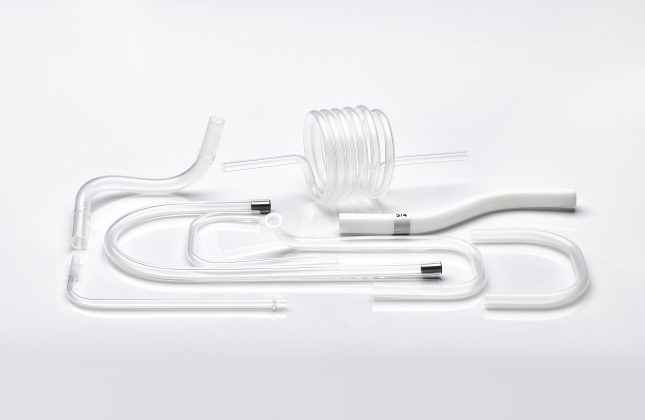
FEP
Why use it:
- Excellent optical safety: very low smoke and good flame resistance → widely used in plenum-rated cables (air-handling spaces).
- Transparent → useful when visual inspection of fibers is needed.
- Low friction → fibers slide easily inside tubes (important during installation).
- Good flexibility compared to PTFE.
Trade-offs:
- Not as flame-resistant or low-smoke as FEP.
- Higher friction → not as ideal for delicate fiber movement.
Typical use case:
Indoor fiber cables, especially in buildings with strict fire codes.

PVDF
Why use it:
- High mechanical strength → better abrasion and crush resistance than FEP/PTFE.
- Good chemical resistance.
- Lower cost than PTFE/FEP in many cases.
- Slightly stiffer, which can help maintain structure.
Trade-offs:
- Not as flame-resistant or low-smoke as FEP.
- Higher friction → not as ideal for delicate fiber movement.
Typical use case:
Industrial or semirugged environments where durability matters more than fire performance.

ETFE
Why use it:
- Outstanding toughness → very high abrasion and cut resistance.
- Radiation resistance → suitable for aerospace, nuclear, or high-radiation environments.
- Lightweight and thin-wall capability.
Trade-offs:
- Higher stiffness than FEP.
- Not as good in flame/smoke performance as FEP.
Typical use case:
Harsh environments (aviation, military, industrial robotics).

PTFE
Why use it:
- Extreme temperature resistance (best in class).
- Ultra-low friction (even lower than FEP).
- Exceptional chemical resistance.
Trade-offs:
- Difficult to process (not melt-processable like FEP).
- Higher cost.
- Less flexible in practical cable constructions.
Typical use case:
Niche, extreme environments (high heat, aggressive chemicals).
Discover More:
We also make products for the following application areas: